✨ At a Glance
Hay fever is an immune reaction to pollen. In southern Australia, grass pollen season mainly runs from October to December.
Research links hay fever in children with disturbed sleep and tics, although it does not prove cause and effect.
Hay fever can disturb sleep, and tired children often find it harder to manage big feelings.
Simple steps at home may reduce pollen exposure, especially in your child’s bedroom.
Your GP is your partner for diagnosing and managing hay fever and asthma.
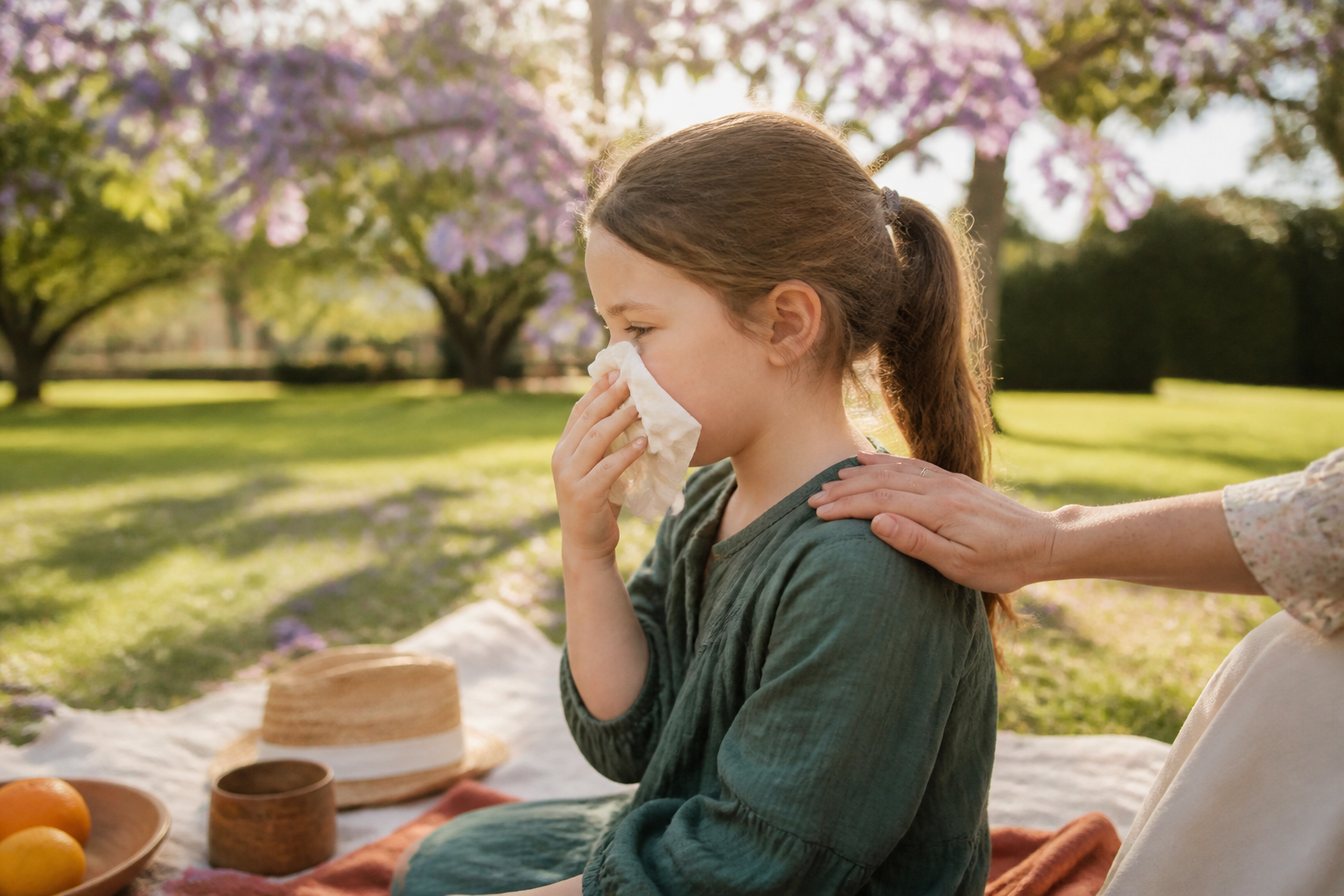
If your child’s tics, anxiety or sleep seem to slip every spring, you are not imagining it.
Many parents in my clinic notice the same pattern. The jacarandas come out, the sniffles start, and a few weeks later things at home feel harder again.
So is hay fever really connected to PANS? Let’s get curious and look at what the research does, and does not yet, tell us.
The short answer: Research has not yet shown that pollen directly triggers PANS flares. However, studies published in 2022 and 2023 link hay fever (allergic rhinitis) in children with poorer sleep and more tics. For a child whose immune and nervous systems are already sensitive, a heavy pollen season may add to the overall load. Sydney paediatric naturopath Ayelet Center, of Botanic Artisan, supports families to track these patterns, reduce pollen exposure gently at home, and work alongside their GP on allergy care.
What is hay fever, and why does it matter for PANS?
Hay fever is the everyday name for allergic rhinitis. It happens when the immune system reacts to something harmless in the air, such as grass pollen, as if it were a threat.
The result is inflammation in the nose and eyes: sneezing, a blocked or runny nose, and itchy, watery eyes.
PANS (Paediatric Acute-onset Neuropsychiatric Syndrome) is thought to involve a close connection between the immune system and the brain. Symptoms such as OCD, anxiety, tics and food restriction can appear suddenly, sometimes after an infection.
The American Academy of Pediatrics’ 2025 clinical report recognises PANS as a real and distressing condition for families, while noting that its causes are still not fully understood.
This is why allergy season matters. When the immune system is already on high alert, any extra immune activity may be worth paying attention to. You can read more in my article on how the immune system may keep the brain on high alert.
What does the research say?
Here is what I find helpful to know, explained simply.
Allergies and tics often appear together. A 2023 review that pooled seven studies found that children with tic disorders were more likely to also have hay fever, asthma, allergic eye irritation, eczema or food allergy. The authors were careful to say this shows a link, not proof that allergies cause tics.
Hay fever can disturb children’s sleep. A 2022 review in a paediatric journal found that hay fever is linked with snoring, restless sleep, insomnia, bedwetting and daytime tiredness in children. Symptoms often feel worse overnight and in the early morning.
Hay fever appears common in children with PANS. An earlier (2018) study from the Stanford PANS clinic found that almost half of the children had a history of hay fever, which appeared higher than in the general population.
What we do not have yet is a study that follows children with PANS through pollen season to see whether flares increase. So I hold this gently. Allergies are one possible piece of the puzzle, not the whole picture.
Why spring may be harder for some children
Here is what I see in clinic, and how the pieces may connect.
More inflammation. Pollen keeps the immune system busy, which may add to the load a sensitive child is already carrying.
Less sleep. A blocked nose, snoring and itchy eyes can mean lighter, broken sleep. Tired brains find it much harder to manage big feelings, worries and urges.
More discomfort. Constant sniffing, throat clearing and rubbing can be exhausting for a child, and stressful for the whole family.
Overlapping triggers. Spring often brings school colds, routine changes and end-of-year busyness at the same time.
The behaviour is never the problem. It is the body asking for help.
Signs that hay fever may be adding to the load
Sniffing, snorting, throat clearing or eye rubbing that is worse outdoors or on windy days
A blocked nose, mouth breathing or new snoring
Dark circles under the eyes, or waking tired
Restless sleep, night waking or bedwetting
More irritability, tics or anxiety on high pollen days
Symptoms that ease when your child is indoors, at the beach or away from grassy areas
A note on tics and allergies. Blinking, sniffing and throat clearing can be allergy symptoms, tics, or both. This can be confusing, even for practitioners. A simple diary is one of the best ways to see the pattern. You can learn more in my guide to tics in children.
How to track pollen and symptoms
Check the daily Sydney pollen forecast on Sydney Pollen Count, run by Western Sydney University, or its free app.
Each evening, rate your child’s sleep, mood, tics or worries, and allergy symptoms on a simple scale from 0 to 3.
Note anything else that changed: a cold, a stressful week, a new food, or time in a damp or mouldy space.
After two to three weeks, look for patterns and bring your notes to your GP or naturopath.
My free PANS Flare Survival Guide includes more ideas for keeping track during harder weeks.
What may help at home
ASCIA recommends these simple steps to reduce pollen exposure:
Stay indoors on windy days when pollen counts are high.
Avoid being outside just before, during or after thunderstorms.
Shower and rinse the eyes with water after being outside.
Keep windows closed at home and in the car, and use recirculating air conditioning in the car.
Stay inside while grass is being mown.
Wear sunglasses outdoors to protect the eyes.
A few gentle additions I often suggest:
Make the bedroom a low-pollen space. Change clothes before bed, wash pillowcases often, and dry bedding indoors on high pollen days.
Protect sleep with a calm, predictable evening routine.
Offer colourful, nourishing meals and plenty of water to support the whole body through a busy season.
How naturopathic support fits in
Naturopathy does not replace allergy care from your GP. Instead, it looks at the whole picture: the gut, immune system, nervous system, sleep and daily rhythms, and how they connect.
For spring, a care plan may include:
Gentle support for the nervous system and sleep
Gut and immune support through food and nutrition
Individualised herbal or homeopathic support where appropriate, always checked against any medicines your child takes
A simple tracking plan, so we can see what is really driving the changes
Every child is different, so there is never a one-size-fits-all approach. Let’s connect the dots for your child.
Working with your GP
Your GP is an important partner, especially in allergy season. They can:
Confirm whether your child has hay fever, and arrange allergy testing if needed
Recommend allergy medicines suitable for your child’s age
Check for asthma, and create or update an asthma action plan before spring
If your child has PANS, let your GP know before starting any new medicine. Some allergy medicines can affect sleep, mood or alertness in children, so it helps to choose carefully together.
When to seek urgent help
Call 000 if your child is wheezing, struggling to breathe, or cannot speak in full sentences, especially during or after a thunderstorm.
See your GP or go to your nearest emergency department if your child:
Has a sudden, severe change in behaviour or mood
Stops eating or drinking
Talks about hurting themselves
Has a high fever, a severe sore throat or seems very unwell
Frequently asked questions
Can hay fever cause a PANS flare?
There is no direct research yet showing that pollen causes PANS flares. However, hay fever is linked with poorer sleep and tics in children, so it may add to the overall load on a sensitive immune and nervous system. Tracking symptoms alongside the pollen forecast can help you see your child’s own pattern.
When is hay fever season in Sydney?
Trees usually pollinate in late winter and early spring. In southern Australia, allergenic grasses mainly flower from October to December, and the weed plantain flowers from August through to May. Pellitory, also called asthma weed, is mainly found in Sydney.
How can I tell if my child’s sniffing or blinking is a tic or an allergy?
It can be hard to tell, and some children have both. Allergy symptoms often come with itchy eyes, a runny nose or sneezing, and ease indoors. Tics may come and go with stress or excitement. A symptom diary and a check with your GP are helpful first steps.
Can a naturopath help with hay fever and PANS?
A naturopath can work alongside your GP to support the gut, immune system, nervous system and sleep, and help you track patterns over time. Naturopathic care does not replace medical assessment or allergy care.
Should my child have allergy testing?
If symptoms are frequent or affect sleep, ask your GP. ASCIA recommends skin prick or blood allergy tests, interpreted by a doctor trained in allergy alongside your child’s history.
Ready for support this spring?
If spring always seems to unsettle your child, you do not have to work it out alone. Together, we can look at the whole picture and make a gentle plan for the season ahead.
Book Your Free 10-Minute Clarity Call
10 minutes, no charge, no pressure.
References
Chang Y, Zhang Y, Bai Y, Lin R, Qi Y, Li M. The correlation between tic disorders and allergic conditions in children: a systematic review and meta-analysis of observational studies. Frontiers in Pediatrics. 2023;11:1064001.
D’Elia C, Gozal D, Bruni O, Goudouris E, Meira e Cruz M. Allergic rhinitis and sleep disorders in children: coexistence and reciprocal interactions. Jornal de Pediatria. 2022;98(5):444 to 454.
American Academy of Pediatrics. Pediatric Acute-Onset Neuropsychiatric Syndrome (PANS): Clinical Report. Pediatrics. 2025;155(3):e2024070334. (AAP announcement)
Australasian Society of Clinical Immunology and Allergy (ASCIA). Pollen Allergy: Frequently Asked Questions. Updated February 2024.
Rosa JS, Hernandez JD, Sherr JA, et al. Allergic diseases and immune-mediated food disorders in Pediatric Acute-Onset Neuropsychiatric Syndrome. Pediatric Allergy, Immunology, and Pulmonology. 2018;31(3):158 to 165.
About the Author
Ayelet is a Sydney-based clinical naturopath, herbalist, nutritionist and homeopath, and the founder of Botanic Artisan Bespoke Holistic Health. She specialises in root-cause, evidence-informed care for women and children, with a focus on children's gut, immune and nervous system health, PANS/PANDAS, sleep and behavioural regulation, and hormonal balance during perimenopause.
She holds formal qualifications in naturopathy, herbal medicine, nutrition and homeopathy and supports families across Australia through personalised, gentle and practical care plans. Through her clinical work, Ayelet has supported many children with complex chronic health concerns including PANS, neuroinflammation and gut-brain dysregulation.
Her work integrates herbal medicine, nutrition, homeopathy and functional testing, combining modern science with traditional wisdom to support balance, resilience and long-term wellbeing.
Learn more about her clinical approach: https://www.botanicartisan.com.au/about
Book your free 10-minute clarity call: https://www.botanicartisan.com.au/bookings
Disclaimer
The information provided in this blog is for your personal or other non-commercial, educational purposes. It should not be considered as medical or professional advice. We recommend you consult with a GP or other healthcare professional before taking or omitting to take any action based on this blog. While the author uses best endeavours to provide accurate and true content, the author makes no guarantees or promises and assumes no liability regarding the accuracy, reliability or completeness of the information presented. The information, opinions, and recommendations presented in this blog are for general information only and any reliance on the information provided in this blog is done at your own risk. Any third-party materials or content of any third-party site referenced in this blog/article/handout do not necessarily reflect the author’s opinion, standards or policies and the author does not assume any liability for them whatsoever.